

Erickson Biography Excerpt

Ron Alexander’s Hypnotic Encounter with Erickson
By Ron Alexander, Ph.D.
Estimated Reading Time: 3 minutes, 25 seconds
The following is an excerpt from the Erickson biography. It was taken from a document Ron Alexander, Ph.D., sent to Jeff Zeig in 2015.
In 1976, Alexander phoned Erickson at the beginning of the week, asking him if he would consult on a personal medical problem. The holistic treatments Alexander tried had not been successful. During that phone call, Erickson asked Alexander to call him back the next day, sharply at 9 a.m. The following days, Erickson asked Alexander to do the same thing: Call him the following day promptly at 9 a.m. Alexander was perplexed, but each day that week he did as Erickson asked. And after each request, Erickson said, “And don’t be late.” On Friday, Erickson finally invited Alexander to Phoenix for the consultation.
When Alexander and his colleagues arrived at Erickson’s home, Erickson was holding a bowl of strawberries and offered them to Alexander. It was as if Erickson knew he loved strawberries and had a bowl waiting for him. Then Erickson invited Alexander to go into trance. Alexander remembered coming out of trance with something Erickson said at the forefront of his mind: “Your unconscious is very creative, is it not?”
Erickson said something else that stuck in Alexander’s mind. During trance, Erickson repeatedly awoke him and said: “Why should we inflict pain on ourselves to…do the right thing?”
After the trance, Erickson asked Alexander if he was brought up Catholic. Alexander told him that he had been baptized Catholic. Alexander then asked Erickson, “How did you know I love strawberries?” Erickson softly replied: “Well, sometimes you can hear in a voice not only what the problem is, but also a delicious solution.”
Erickson put Alexander in a trance again and elicited an arm levitation. He asked Alexander if he taught at U.C.L.A. Alexander answered yes. Erickson asked if there were T-shirt shops in the area. Again, the answer was yes. Erickson then gave Alexander a specific assignment: To make a T-shirt with the front saying: “Why Should We Inflict Pain on Ourselves in Order to…” And the back was to read: DO THE RIGHT THING?! Alexander returned to California and had the T-shirt made.
At the next appointment in Phoenix, Alexander promptly arrived at 9 a.m. to see Erickson. Erickson asked Alexander if he were a happy type or the guilty type. Alexander responded: “At the moment, the guilty type.” He then shared with Erickson that he was not in a fulfilling marriage; he and the “lovely woman” he married were unfortunately not compatible. Erickson’s reply was that music bands often try out new musicians and replace band members for the sake of making better music — and that no one should feel guilty about this. He said that in life, some arrangements are kept, and some need letting go because they are not flowering. Erickson said, “Are you aware that your unconscious is up to something interesting and it’s always orienting toward?!” Alexander recalled being in and out of trance, and awakening three hours later, remembering only some of Erickson’s words.
As Alexander was leaving, Erickson asked, “Sonny, are you from Boston?” Alexander replied yes. Erickson continued: “Well, I know there are a lot of Catholics up there. Are they happy or guilty?” He then smiled at Alexander and told him to wait 10 days before being retested for the medical issue that Alexander had presented to him. Erickson also asked Alexander to get back to him with the results. Erickson said that he may be surprised and delighted to discover that his infection had suddenly disappeared.
Ten days later, Alexander was retested, and there was no sign of infection. Alexander also concluded that even though he was raised Catholic, he did not need to feel guilty about not wanting to end his marriage.
Reflecting on what he learned from Erickson, Alexander said that whenever he thought he had a psychosomatic symptom, he would go into trance and remember Erickson’s words: “Why should we inflict pain on ourselves to…do the right thing?!” After his visit with Erickson, he also decided to redirect his career to mind/body medicine.
You may like…

por Jeffrey K. Zeig
Tipo: Tapa Blanda
La Anatomía del Impacto Experiencial es el segundo volumen de una serie, y puede leerse independientemente de los otros libros de la serie. El primer volumen, The Induction of Hypnosis (2014), presentó el modelo de hipnosis del Dr. Zeig. El tercero, Psychoaerobics (2015), presentó un método experiencial de desarrollo terapeuta. En este libro, encontrará un modelo de terapia breve que puede aplicarse independientemente de su modelo preferido de terapia. El cambio en la terapia se obtiene mejor por las experiencias que vive la gente, no por la información que reciben. La hipnosis es fundamentalmente un método experiencial, cuyo imperativo es: "Al vivir esta experiencia, puedes recuperar tu capacidad para cambiar o enfrentar adecuadamente". La anatomía del impacto experiencial a través de la psicoterapia ericksoniana promueve métodos experienciales que se derivan de una orientación hipnótica, ofreciendo un plan paso a paso para crear una terapia breve basada en la experiencia.
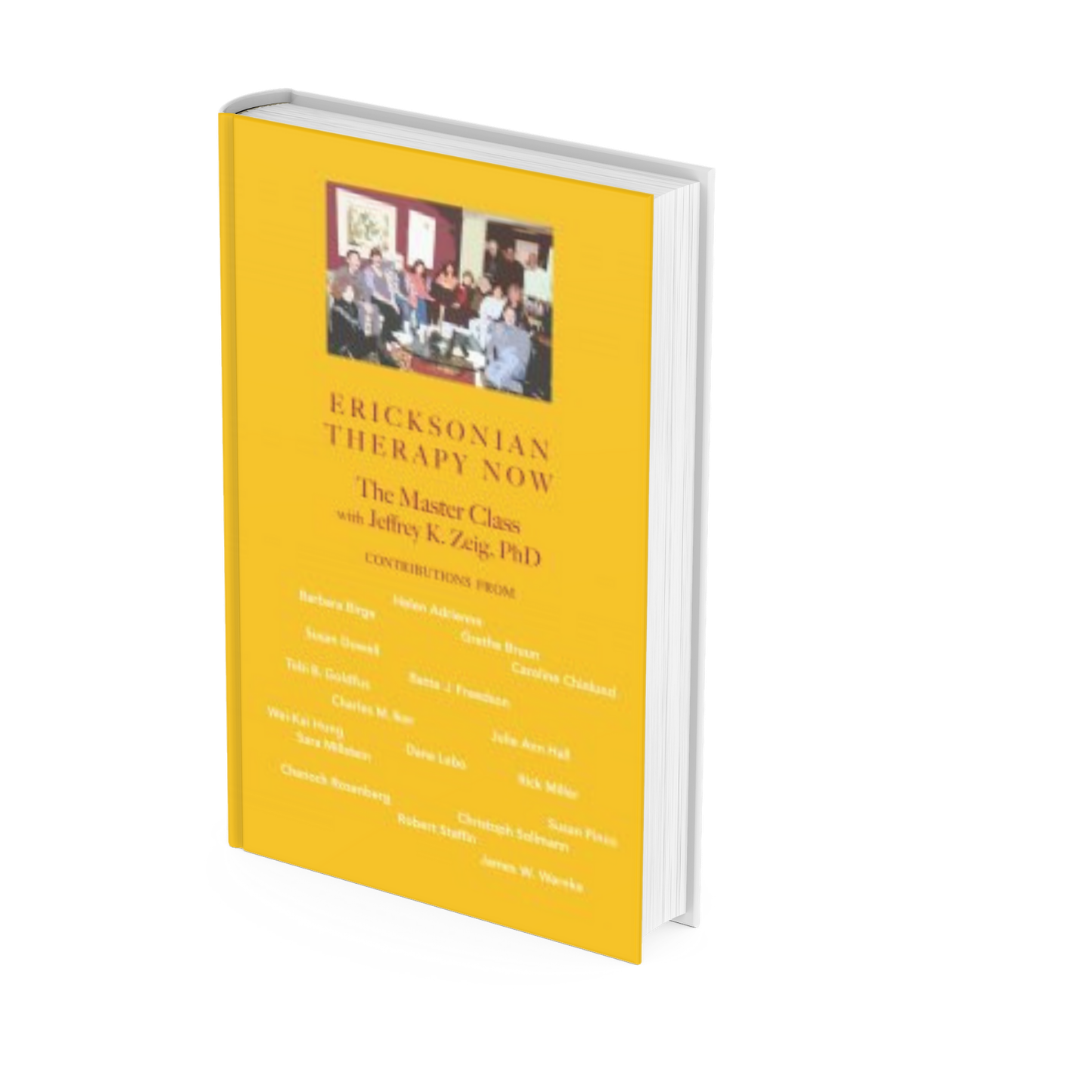
The Master Class with Jeffrey K. Zeig, PhD
by Jeffrey K. Zeig
Type: Hardcover
Milton Erickson was my mentor intermittently for more than six years; he was also an inspiration in creating the Master Class. At his essence, Erickson was experiential. He was the most radically experiential therapist to ever practice. Creating transformative experiences is a component in many schools of therapy, including rational emotive behavior therapy and cognitive behavior therapy, but for Erickson being experiential was not merely a component; it was most of his therapeutic work. Hypnosis is essentially an experiential technique. The subtext of hypnosis is this: “By living this experience, you can be different.” Hypnosis is not a means of providing information.
This book is an opportunity to study single-session therapies that are based in experiential methods. The learning from these methods is primarily stimulated by the client living the change, not by intellectual understanding of how to change. The participants declare what they are going to do differently and the sessions are designed to create experiences that foster the accomplishment of stated goals. Participants have solved complex problems and have made significant life changes. They have overcome writer’s block and then completed a book; they are happier in their jobs and relationships; they rebalance work and life; and they surmount childhood trauma.
The transcripts contained here offer opportunities to sit in on live interactions between therapist and client. An extraordinary adjunct to the transcripts are the participants’ — all stellar professionals themselves — notes on the sessions. They are able to articulate their understandings and impressions in such powerful ways that upon reading their perspectives I also took away something new.
Jeffrey K Zeig